


- What We Do

- who we help
- What We Do
- Who we help
Orchestration in Isolation: Why Supply Chains Still Can’t Understand the Whole Picture
You can see the link here: https://www.linkedin.com/pulse/orchestration-isolation-why-supply-chains-still-cant-whole-pradhan-luaze/

I was listening to a webinar a couple of weeks ago, and the guest speaker said, “visibility is table stakes.” Really?!?
To be fair, I may be taking a few words out of context, but the message was repeated enough that it’s worth calling out. So, I am going to go on a rant because this is important. You’ve been warned.
Today, we have a lot of “control towers” and “command centers” (and everything in between) on the market that only offer partial visibility to customers or suppliers, or transportation or planning or manufacturing or…. or… and partial decision making (what to do about transportation, or warehousing, or customers or suppliers or production plans or… or… what to do in the short-term or the mid-term or the long-term). In other words, they are functional in focus – there are too many “ORs” and way too few “ANDs”. None of these “control towers” or “command centers” are end-to-end.
These functional control towers and command centers perpetuate functional and domain thinking. They reinforce the PLAN, SOURCE, MAKE, DELIVER model which is functional, isolated thinking.
If a company relies on technology that only offers partial visibility, it cannot fully connect, align, and synchronize data, analytics, decisions, and processes across all decision layers, functions, domains and so on. Consequently, it struggles to understand relationships, perceive cause-and-effect throughout the supply chain, track and evaluate supply chain business value, or comprehend interdependencies.
If we want to orchestrate (and “control”) the supply chain, we need to see and use the visibility to make decisions … meaning, we need the data visibility, the process management, and the decision-making capability across the entire ecosystem. At a high level:
- Data visibility to see what’s going on in and across the supply chain
- Decision making to analyze the trade-offs at the right time
- Process orchestration to make things happen in the right place
While also taking into account:
- Outcomes-led decisions: focused on making decisions that achieve the results that matter to the business
- Real-World Context: recognizing and working within the real limits that exist (time, cost, capacity, resources) and using them to guide smarter, more practical decisions instead of treating them as obstacles.
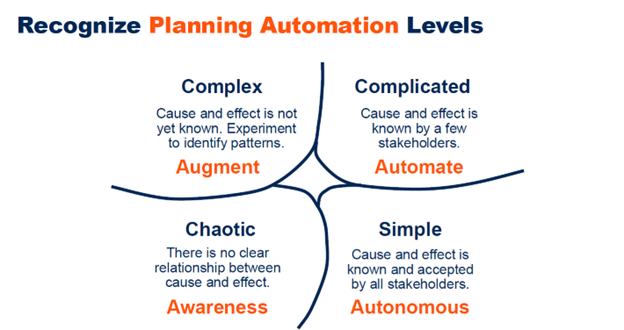
- Degrees of Supply Chain Automation: varying degrees of automation, augmentation, and autonomous that need to be tailored based on the specific planning decision. As a result, not all planning decisions will be autonomous. A good reference is the Cynefin Framework.
Supply Chain Orchestration Platforms
Over the last year, there has been increasingly more messaging and vendors rebranding their solutions to Supply Chain Orchestration Platforms (or some variation of this). Every term gets corrupted by the market eventually – this has happened with “IBP”, “Digital Twins”, “Digital”, “AI”, and I’m sure Orchestration will soon be added to that list.
Lately, there’s been a lot of news from technology providers enhancing their orchestration platforms by introducing (or hinting at upcoming releases of) AI agents, agentic workflows, AI agent studios, and marketplaces. These capabilities are being designed to work together and support companies to advance along in their decision continuum journey; with the intended goal to orchestrate decisions end to end.
All these capabilities are just some of the different pieces of the puzzle, each valuable, and a step ideally in the right direction.
I want to expand on this point a bit…. so bear with me here 😊
There’s a bit of an “arms race” happening today. Technology providers are rapidly building and deploying AI Agents, but agents alone aren’t enough. They need agentic workflows to reliably access and act on core enterprise systems and data; enabling digital workers to collaborate, hand off tasks, and make coordinated decisions across end-to-end processes.
They also need agent studios, where companies can design, test, and train agents tailored to their specific business needs. Marketplaces are emerging as well… think of these like an enterprise version of the iPhone App Store where developers or super users can easily discover, share, and connect agents, external systems, data sources, analytics, and models. The marketplace is one important source to provide the data (context) and analytics (intelligence) to power the AI agents.
And even if all this architecture is in place, you still need a way to monitor and govern decisions with strong guardrails and engagement rules that guide the behavior of actors in complex adaptive systems; defining obligations, permissions, and prohibitions. I really like an article that was written some time ago Pieter Van Schalkwyk and Dr. Zoran Milosevic that expands on this topic here.
But let’s be clear, it is still early days. In their current form and level of maturity, most supply chain orchestration platforms deliver orchestration in isolation. Why?
1. Most AI Agents focus on automation and augmentation (doing things right and fast) versus decision-making (doing the right things and improving efficiency)
2. Most AI Agents lack true agency such as learning from experience and continuously improving over time, ability to predict with causal understanding, and ability to reason autonomously.
3. Marketplaces are still emerging and, for now, mostly resemble virtual app catalogs rather than true API marketplaces with agent-ready tools that can be reliably discovered and called.
4. Most agentic workflows today are still largely deterministic, rules driven workflows.
True agents don’t just follow a pre-determined sequence of steps; they observe their environment, reason about what they perceive, plan their approach, and take action while adapting to changing conditions and learning from outcomes.
Mastering end-to-end orchestration depends, among many things, complex semantic relationships. Systems must understand how data, decisions, and events relate to one another beyond surface-level connections. It’s not just linking data, it’s link meaning. Context.
The challenge today is that there’s no end-to-end context. Decisions don’t “know” their influences on each other, can’t adapt to prior decisions or anticipate future paths, and aren’t optimized across the broader system. This creates a disconnected decision experience — a series of isolated intelligent actions without shared understanding or memory.
When one agent’s “inventory adjustment” carries implications for another’s “production reschedule” or “delivery reprioritization,” those interactions, and the relationships, create the web of context that enables adaptive, coordinated action across the global network. Without that shared semantic understanding — that shared language of cause, effect, and intent — agents can automate, but they can’t truly collaborate.
Without that end-to-end context, the result is a disconnected decision experience — orchestration in isolation, where agents act intelligently within their lane but still lack the broader context that makes a supply chain truly adaptive and responsive.
Creating True Business Value
I want to go back and challenge a bit the idea that “visibility” helps to create business value. Much of the market is still focused on the belief that if only we could see and sense everything, we could plan our way out of disruption. The belief goes that with enough execution visibility, the system will create a better plan, recommend a better scenario, automate a response; and that resilience will naturally follow.
As with any shiny new idea, the excitement comes first. Then reality sets in. Orchestrating and synchronizing end-to-end supply chain and decision-making processes isn’t easy. Siloed organizational structures, old habits, and company culture don’t change just because the technology did.
I hope I’m wrong. But my fear is that the supply chain orchestration platforms entering the market will gravitate toward the easier stuff….the easy wins — “see” what’s happening in the short-term horizon and help “execute” in real time across the multi-enterprise network.
That’s fine, but let’s not pretend it’s orchestration.
With the inevitable rebranding to autonomous or AI-powered orchestration, organizations will convince themselves they’re truly orchestrating — right? In practice, they’ll just be automating the easy bits and responding to disruptions a little faster.
Valuable? Yes.
Transformative? No.
If I can make a final point is that as companies are curating together the different pieces of their technology roadmap, it remains critical that they build up their capabilities to transform visibility into knowledge and value. Along that journey, they should place a bigger emphasis on building a probabilistic-focused digital supply chain twin: a virtual, real-time, holistic view of the supply chain.
I believe this is the silent wave of innovation.

Sign up for ideas worth revisiting.
Stay connected with updates on our projects, process, and what we’re learning along the way.
TABLE OF CONTENT