

- What We Do

- who we help
- What We Do
- Who we help
World Peace and AI Devotion: A Miss Congeniality Moment
Here is the link: https://www.linkedin.com/pulse/world-peace-ai-devotion-miss-congeniality-moment-alex-pradhan-pgrke/

There's a scene in Miss Congeniality—yes, the Sandra Bullock movie from the early 2000s that still makes me laugh out loud every time I see it.
One by one, the beauty pageant contestants step up to the microphone and answer the same question: "What's the most important thing our society needs?"
Without fail, they flash their vapid smile and reply: "World peace." The crowd erupts in applause every single time.
Then comes Sandra Bullock's character, an undercover FBI agent playing a beauty pageant contestant who doesn't quite fit the mold.
She blurts out, "Harsher punishment for parole violators."
The room goes silent. Crickets.
Then she remembers the script and adds, "…and world peace."
Instant standing ovation.
The beauty pageant scene is no doubt funny, but it also exposes an uncomfortable truth: sometimes we say what we're supposed to say, not because it's meaningful, not because we're finding the 'right' answer, but because we're terrified of the silence that might follow if we don't. We continue to reinforce the ritual. Everyone knows what to say, everyone says it, everyone else expects it, everyone applauds.
(see video link in the LinkedIn Article)
AI Is The New 'World Peace'
Ask any supply chain planning tech vendor what makes them different, and you’ll usually hear a familiar chorus:
“AI-powered supply chain orchestration. Powered by Agentic AI. Game-Changing AI. AI-driven decision-making intelligence. End-to-end. Real-time.”
It’s the safe, expected choice, filled with the customary catchphrases and mandatory buzzwords that guarantees applause. No one will be met with silence.
But here's the problem: when everyone says "world peace," the words lose all meaning. AI has gone from differentiator to table stakes to white noise. Every vendor claims it, every pitch deck features it, every demo promises it. The market has moved beyond AI washing into something worse—AI devotion.
Companies have stopped asking tough questions and have become too used to hearing safe answers. For supply chain planning tech vendors, the fear of being different has created a chorus of sameness, and frankly, it's become boring.
The Courage To Change The Script
Over the last several months I've been having conversations with many vendors and I have come to notice a pattern that seems to be repeating. Many vendors are aware, or at least suspect that the AI chorus is noisy, but few have the appetite to shift the narrative and evolve their playbooks, given the competitive pressure and cautious business climate.
My take: “AI fatigue” will start to set in soon. Vendors need a smarter, more human-centered messaging strategy.
AI isn’t going away. To be very clear, there is considerable value in the different technologies and techniques that make up AI. But the narrative is morphing into irrational devotion and borderline obsession with AI.
I believe we are at the inflection point where AI fatigue is setting in. If you are in product, strategy, marketing, technology you will no longer be able to just slap on the “AI-powered” label carelessly. People are already tuning out.
Gen AI has entered the “trough of disillusionment phase” in Gartner’s Hype Cycle. It is following the predictable adoption curve: experimentation, disappointment and skepticism, refinement, and selective scaling of high-value use cases. The early day excitement of chatbots and co-pilots from a couple of years ago is now considered table stakes. As much chest pumping as there is about AI, the reality for many companies is that they lack the cultural risk tolerance to support emerging tech. Very few companies have incentive structures that reward learning from failure (for example, tying management bonuses to experiments, even failed ones) or the resources to dedicate teams exclusively to innovation.
A New Playbook
Ever notice that Apple doesn’t market “agents”? They don’t market AI as the primary selling point of its products. Rather, it designs experiences that make AI invisible, useful, and deeply human.
Apple’s vision for AI is deeply embedded within its ecosystem. While other companies are focusing on AI as a stand-alone product or service, Apple views AI as a crucial part of the broader Apple experience. Whether it’s on-device machine learning or seamless integration between hardware and software, Apple’s approach to AI revolves around creating a connected, intuitive user experience across all of its devices. It’s about the customer experience.
Supply chain planning software has a similar goal – to create a connected decision experience by having an end-to-end context of the broad picture of a company's supply chain.
And perhaps the supply chain planning tech community can learn a bit from Apple.
So where should they start?
Focus on the long-term vision and strategy. Don’t sell the hype. Build the next-generation that builds value.
Start by answering:
- What’s your north star?
- What is your future vision of supply chain planning that you are building toward and how will you guide customers there?
- How are you serving the customer's needs today and going into the future?
- What do you choose not to do?
These questions may sound almost childlike, but I’ve sat in countless presentations where the story got lost beneath a tangle of architecture diagrams, feature slides, and fashionable acronyms. In the end, no one really answered the simplest question: How, exactly, are they uniquely creating value for the customers in their AI journey and to help them in their digital transformation?
AI Questions That Start Real Conversations
Every vendor is selling the same AI dream.
Increase productivity. Cut costs. Boost efficiency. Manage risk. Automate intelligently.
If you're walking the expo floor this fall/winter or speaking with a tech vendor, I ask that you pause and reflect. The answer isn’t to abandon the tool and shy away from technology – but to go back to the craft of the supply chain. To treat the ‘tool’ as an instrument. That means taking it apart, studying how it’s made, understanding its limits as well as its strengths – and then using it consciously with curiosity, judgment, and intent.
Here are some questions that can help you push the conversation beyond marketing slogans and AI pageantry.
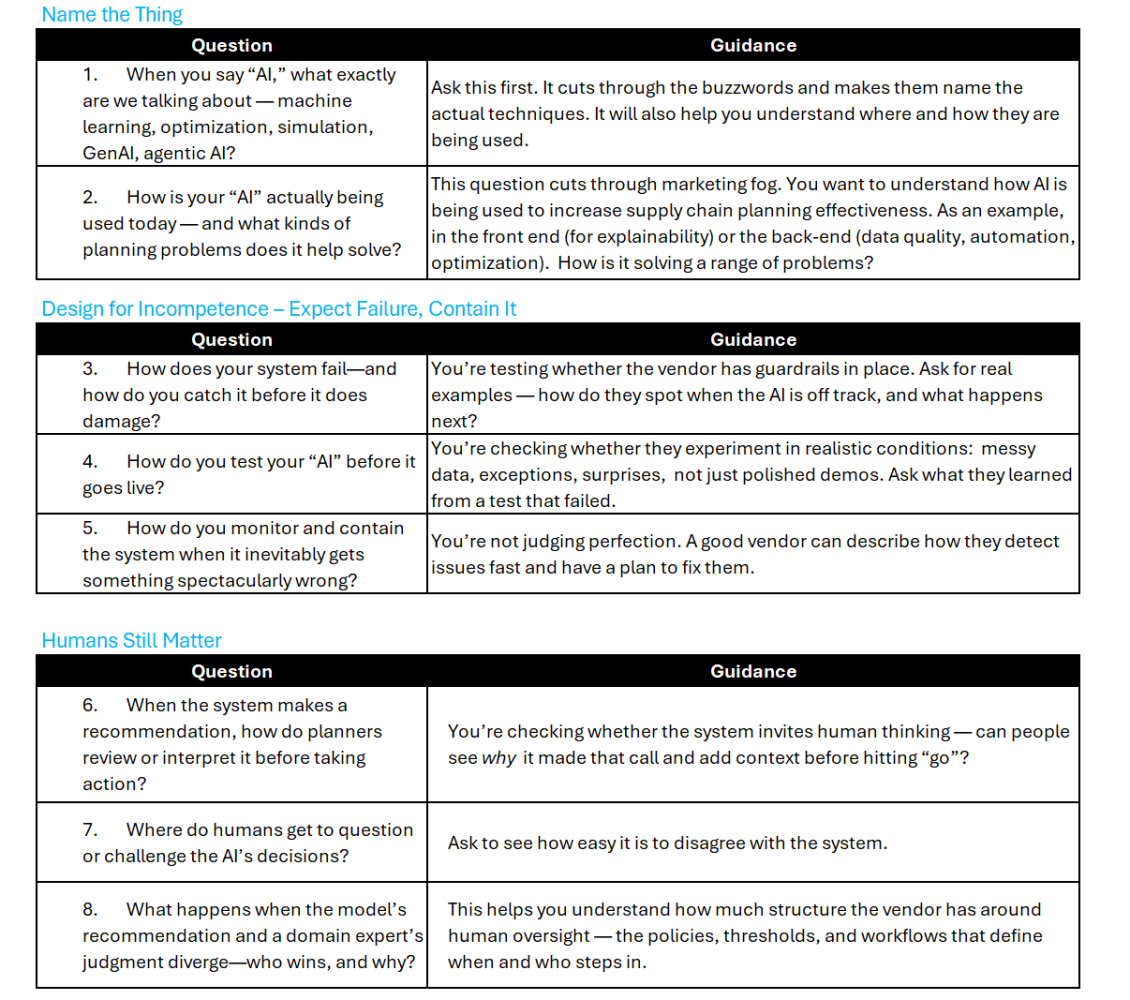
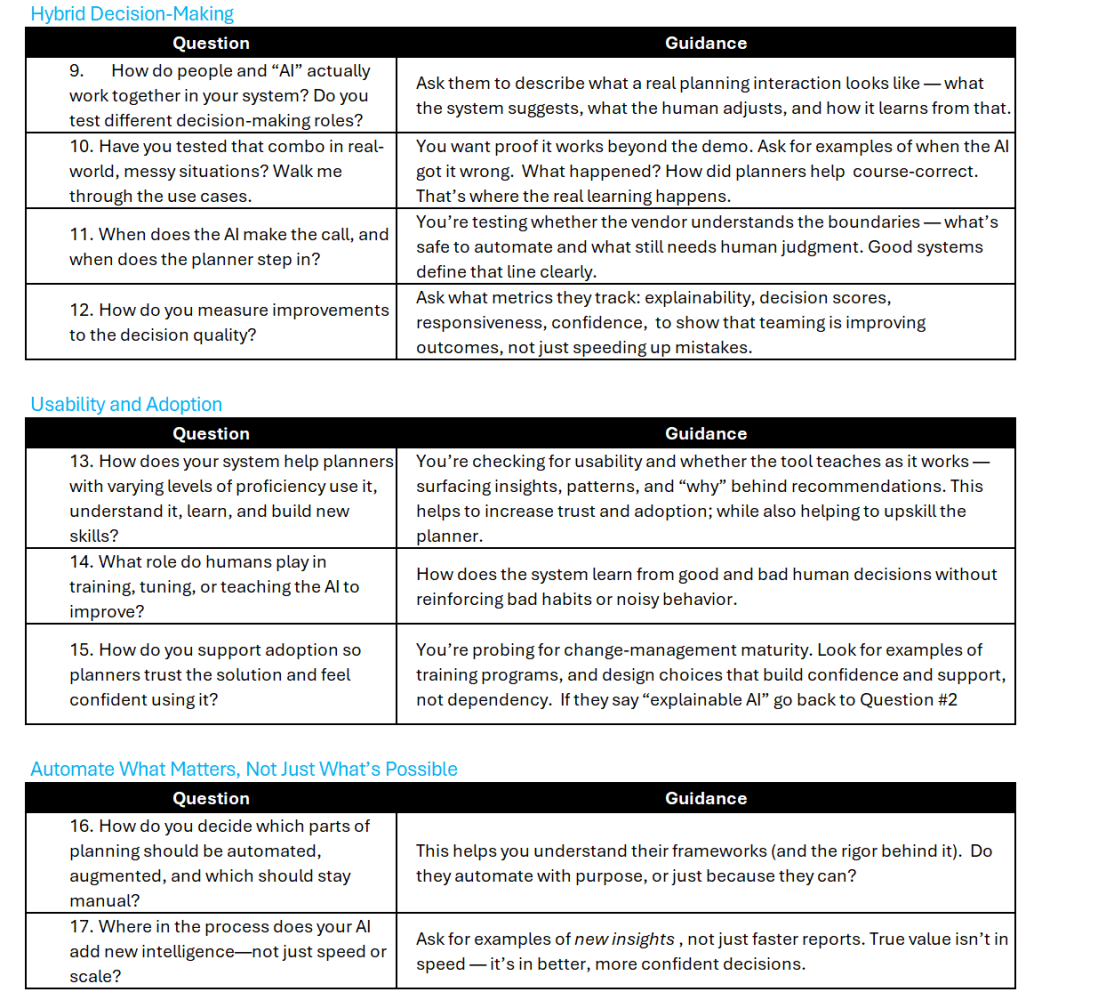
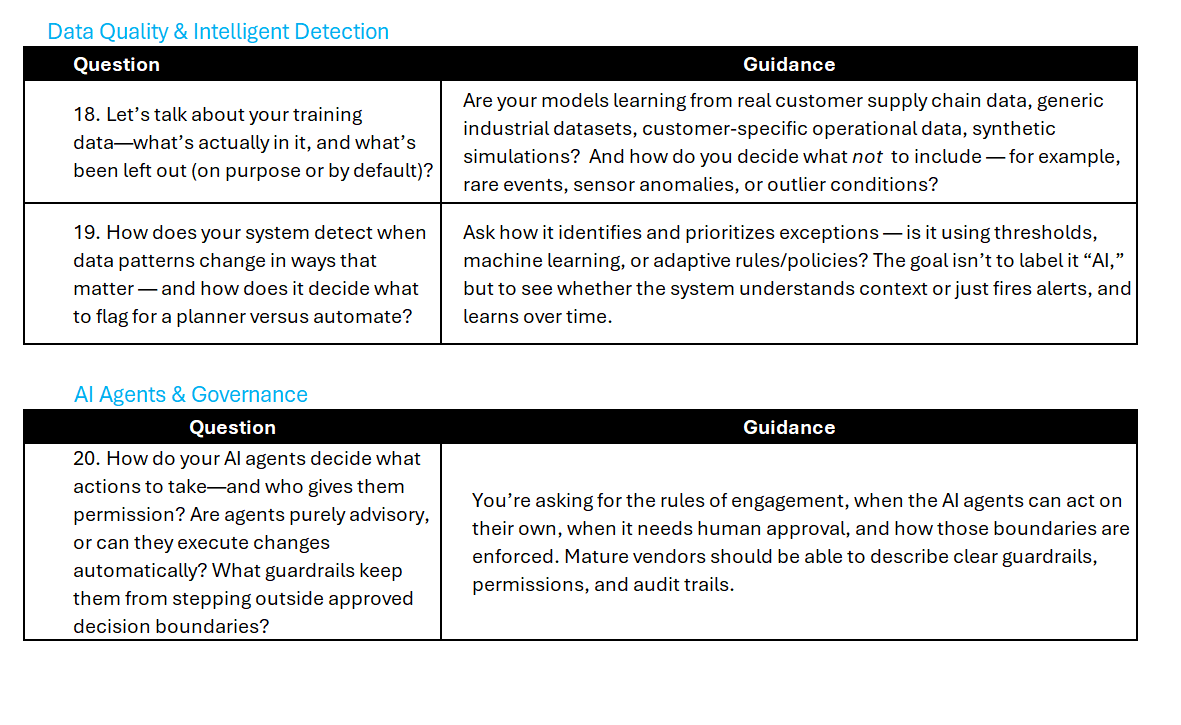
The next time you’re tempted to nod along to “AI-powered, supply chain orchestration, game changing agentic-AI,” try my four year old son’s approach:
But why?
How?
What is that?
Turns out, simple questions expose more truth than any demo ever will.

Sign up for ideas worth revisiting.
Stay connected with updates on our projects, process, and what we’re learning along the way.
TABLE OF CONTENT