


- What We Do

- who we help
- What We Do
- Who we help
Is the Autonomous Supply Chain Too Good to Be True:

A few weeks ago I was at the Gartner Supply Chain Symposium. The keynote is always something I look forward to. Gartner tries to weave together their key insights and predictions into a theme that gives companies a sense of where the market is heading. Some years it lands, some years it misses. It is a tough job to pull off in ~45 minutes. This year the theme was Leading Supply Chain Into the Autonomous Era.
I will be honest: the word "autonomous" without the right context makes me a little prickly.
Why? Because most supply chain leaders are bombarded daily with articles and marketing messages that idealize some future state of “autonomous planning with AI” rather than grappling with the messy reality of where they are. The promise of 'autonomous planning' rests on a flawed vision: that humans simply get freed from decision-making burdens. What that vision ignores is that bringing AI into the supply chain introduces a powerful new player- one that actively changes how work gets done, what opportunities are available to people, and who is actually in control of making decisions.
And yet the conclusion most companies land on is that they should be automating 100% of their planning decisions. They shouldn’t. No company will achieve autonomy in 100% of its planning decisions.
The autonomous era framing is inspiring, and I do believe supply chains need to think differently. But too many of the supply chain leaders I spoke with at the conference are already overwhelmed. They have been handed a mandate to implement AI without a clear view of what that means or how to get there.
So let’s break it down and get into the practical and understand which planning decisions can be automated.
What Does 'Autonomous' Actually Mean?
In plain terms, autonomous means a system can carry out tasks and adapt to new information without direct human guidance or intervention. In supply chain planning, Gartner defines it as the ability to create, evaluate, approve, and act on supply chain plans without a person in the loop. When both the prediction and the prescription—the choice of which plan to execute—are fully automated, the planning system operates autonomously, meaning a plan is created and carried out without a human directly involved in that specific decision loop.
Here is where things get interesting. According to a Gartner survey, only 6% of companies can do this today, even for selected parts of their organization. At the same time, 84% of companies say they expect to increase their AI and automation investment over the next year.
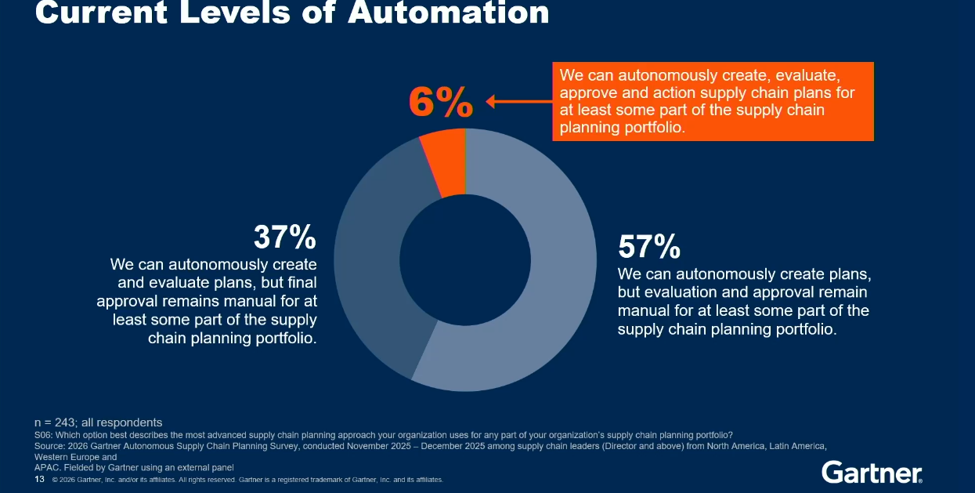
Gartner Autonomous Supply Chain Planning survey: Current Levels of Automation
There is clearly a gap between intent and reality. Part of closing that gap is understanding what we are actually trying to automate.
What Autonomous Planning Looks Like in Practice
Before anyone gets lost in the buzzwords, let me offer three grounded examples of autonomous planning that companies are pursuing today:
• Autonomous data cleansing. The system automatically detects and corrects data quality problems, things like outliers, missing values, and errors in master data, without a planner touching it. Better inputs, better outputs.
• Autonomous replenishment. Based on real-time demand signals, inventory levels, and supplier lead times, the system calculates and places purchase or production orders on its own. The parameters are understood, the rules are clear, and there is no ambiguity about what good looks like.
• Autonomous order promising. When a customer places an order, the system instantly calculates Available-to-Promise and Capable-to-Promise using live data and constraints. A delivery commitment is confirmed without waiting for a planner to review it.
What these share is that they are simple, repeatable, and very rule-based. Everyone agrees on the right outcome. The logic is transparent. That is the environment where full automation can be trusted.
Not All Planning Decisions Can Be Autonomous
Another recent survey asks supply chain professionals about their views on what capabilities AI will achieve over the next three to five years. 85% of supply chain decisions will still require human review while only 15% will be fully automated. This is not a failure of technology, but rather it reflects the nature of decision-making and that not all decisions are the same.
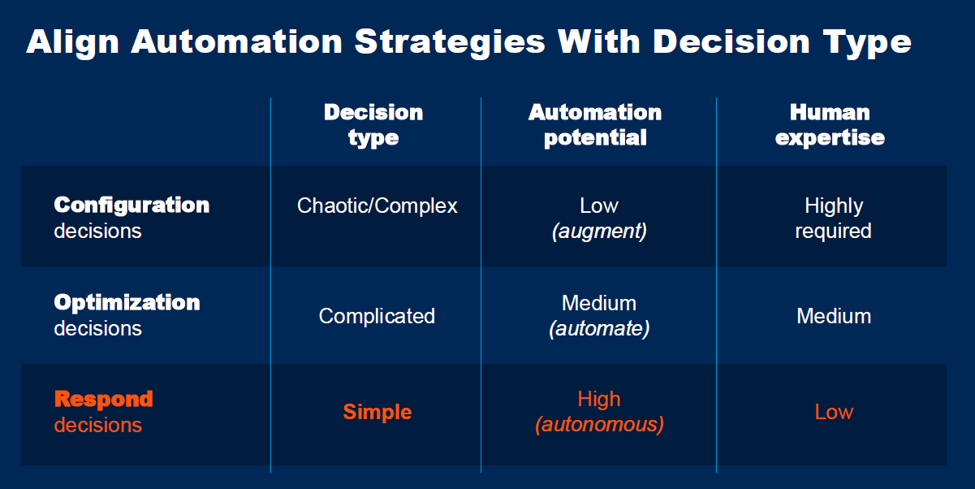
To understand why this is the case, it helps to categorize supply chain decisions based on their complexity, impact, and how well we understand their cause-and-effect relationships. It is helpful to segment these into three main types:
1. Simple Decisions (The 15% - Fully Automated) These are typically operational "respond" decisions in the short-term horizon. In these cases, the cause-and-effect relationship is known and universally agreed upon by stakeholders. Because these decisions are characterized by high volume, low risk, and clear parameters, they are perfect candidates for full autonomy.
- Examples: Autonomous data cleansing, automatically reordering stock when inventory drops below a specific threshold, or instantly calculating delivery dates to confirm customer orders, or how to reschedule an order on a disrupted production line.
2. Complicated Decisions (Human-Augmented) These are tactical "optimization" decisions with a medium-term horizon and moderate complexity.
- Examples: S&OP type choices about how to best utilize the supply chain you have: balancing supply and demand, allocating constrained inventory, managing production schedules, or deciding how to react when a main supplier can suddenly only deliver half of the required raw materials.
- Why the need for humans: While technology can run thousands of scenarios and suggest alternatives, human judgment is still required to make the final decision and weigh the different options against operational constraints and current business priorities.
3. Complex/Chaotic Decisions (Human-Led) These are strategic "configuration" decisions with a long-term horizon and high impact choices about the supply chain structure, where the relationship between cause and effect is not entirely predictable.
- Examples: Deciding where to build a new manufacturing plant or distribution hub, how to design the supply chain for a new product line, what trade-offs to make in the face of geopolitical uncertainty.
- Why the need for humans: These decisions often require diplomacy, negotiation, and balancing the conflicting priorities of multiple stakeholders across an ecosystem. Technology's role here is simply to provide data and insights to support the human decision-makers
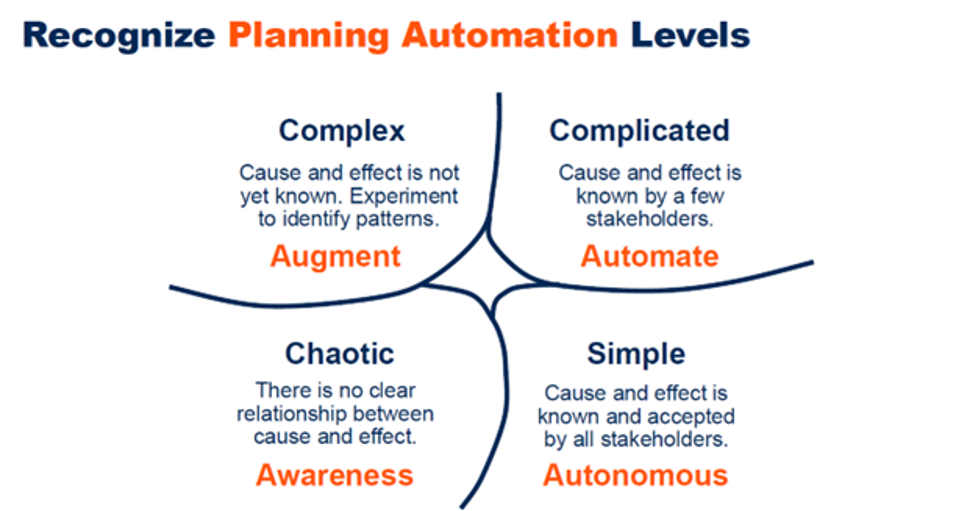
Cynefin Framework
The key point here is to not automate everything but to match the level of automation to the type of decision. Automate the respond/short term decisions. Augment the optimization ones. Support the strategic ones.
We Need to Think Differently, Not Just Move Faster
This is the part of the autonomous conversation that gets missed most often: most organizations use technology simply to do the same things they have always done, just faster. That is not transformation. In fact, Gartner's data makes a sobering point about simply adding digital technology to existing strategic decisions: 78% of supply chain leaders report their decisions are still inefficient, 60% say the technology actually tempted them to make riskier choices, 55% say their decisions come too late, and 52% admit they still make poor decisions. Speeding up a broken planning process does not fix it.
What the autonomous era is really asking for is a different way of planning altogether. Three shifts stand out:
• Batch to continuous. Moving away from weekly or monthly planning cycles toward planning that runs continuously and responds to signals in real time.
• A few scenarios to thousands. Technology makes it practical to model hundreds or thousands of scenarios across different assumptions. Planners can choose the best path rather than working with the only feasible one they had time to build.
• Static processes to agile ones. Rather than following the same 10 or 15 steps every single time regardless of the situation, planning processes can be structured to bring in the right people at the right moments and skip steps that are not relevant.
All three of these require automation to work. But the goal is not automation for its own sake. It is making better decisions, faster, at a scale that was not possible before.
AI Is Not Just GenAI and Agentic AI
Today, unfortunately, when people hear AI, many default to thinking about chatbots or large language models. The real opportunity comes from combining a much wider set of technologies and techniques. Statistics, optimization, simulation, machine learning, knowledge graphs, heuristics…. and the new cool kids on the block, GenAI and agentic AI. Each one serves a different purpose. The supply chains making the most of this shift are using these tools together, not treating any single one as the answer.
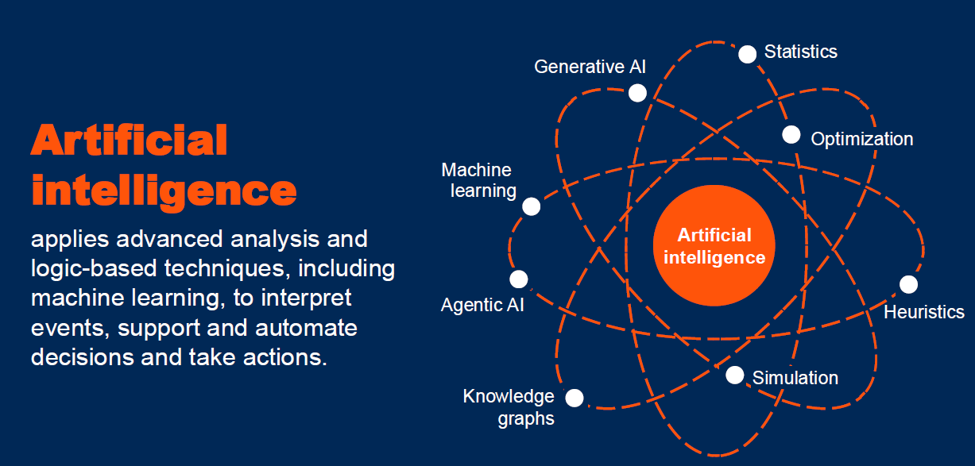
AI is more than GenAI and Agentic AI
What This Means for Planners
The planner role does not disappear. But it changes significantly.
As technology takes on more of the routine work, the value a planner brings shifts toward strategic oversight: driving governance, translating business strategy into the rules, priorities, and guardrails that the technology needs to act on, and then evaluating whether what the technology produces actually makes sense. These are things a system cannot figure out from data alone.
One of the more interesting predictions I heard was that “by 2030, 50% of companies will face higher costs and lower service levels because they lack planner talent capable of judging the recommendations that AI systems produce.” The autonomous era does not reduce the need for human expertise. In many ways it raises the bar for what that expertise needs to look like.
And the number one barrier to getting there, according to the same survey is surprisingly not technology, but it is organizational. Culture, governance, talent, and the willingness to redesign how decisions get made.
So where do you start?
1. Avoid setting unrealistic expectations. Do not define autonomous planning as the whole of planning. Link planning automation goals to the type of planning decision.
2. Map your planning decisions. Before automating anything, get clear on which decisions you actually make, how often, with what complexity, and how reversible they are. Not all decisions should be treated the same way.
3. Start automating the simple ones. Find the high-volume, rule-based decisions where there is clear agreement on the right outcome. Automate those first, with guardrails, and use them to build organizational confidence and trust in what the technology can do.
4. Set realistic and progressive goals for planning automation. Achieve early automation wins by focusing on the planning decisions in the short-term area.
5. Invest in the planners of the future. Redefine what great looks like in a planning role. The skills, incentives, and career paths need to align with where the role is going, not where it has been.
Autonomous planning is not something you arrive at in one move. It builds over time, decision type by decision type. The organizations making real progress are the ones taking a deliberate, structured approach rather than chasing the broadest possible vision all at once.
For those of us who still get a bit prickly when the word 'autonomous' gets thrown around: that instinct is worth keeping. Be skeptical of any promised end-state. Instead of looking for a clear path, map the present, establish a sense of direction, and build the path by taking the next right step.
Hat tip to Gartner's Pia Orup and Tim Payne for the research that informed this.

Sign up for ideas worth revisiting.
Stay connected with updates on our projects, process, and what we’re learning along the way.
TABLE OF CONTENT