

- What We Do

- who we help
- What We Do
- Who we help
The Fallacy of the RFP - Focus on the Supply Chain Planning Criteria That Really Matter
This is the link to the article : https://www.linkedin.com/pulse/fallacy-rfp-focus-supply-chain-planning-criteria-really-pradhan-cl2de/

The Fallacy of the RFP - Focus on the Supply Chain Planning Criteria That Really Matter
When I was 16, my first car was an old, beat-up Ford Ghia. The car was on its last leg, but it gave me exactly what I needed back then — status, freedom, and the illusion of being cool. The power windows sometimes worked, sometimes didn’t. The AC blew hot air, which is not a good thing when you live in South Florida. After about a year, the transmission started to go out (that cost me my entire summer job paycheck). It had so many problems I can’t even remember them all, but it served its purpose: it got me to school (mostly) on time. Somehow, the car held on long enough to eventually be passed down to my two younger brothers until eventually the radiator exploded.
Why do I tell this story? Because when you’re young and still learning, that type of car is exactly what you need. A few extra bumps and dents didn't matter (I still blame those on my brothers) 😊
My next car was a Toyota Corolla. True to its reputation, I drove it on the road for nearly 15 years—logging 255,000 miles —until my daughter was born. It was reliable, fuel-efficient, no frills, a workhorse. That car carried me through my 20s and into my mid-30s, and I loved it.
But then my needs changed. With a growing family, safety and needing A LOT more space became my top priority. I was ready to upgrade to a small SUV. I wanted a bigger trunk, a car higher off the ground (worried about getting stuck in Florida rain), built-in tech so I could plug in my iPhone and see Google maps on the screen (remember my 2001 Toyota Corolla came standard with a cassette player), and I was eyeing those fancy optional features like air-conditioned seats. With more disposable budget, I could afford extra features and was prioritizing long-term reliability than just initial cost. The Hyundai Santa Fe was the one that ultimately met my needs, and to this day I still have it.
The needs that I had, and my criteria, changed – and will continue to change - as I progress through different stages of life.
Why This Matters for Supply Chain Planning Technology
I like to tell this story when talking about supply chain planning technology because most people can relate to buying a car. Just like all cars will take you from point A to point B, not all cars are the same. A minivan is different from a truck, which is different from a convertible, which is different from an SUV.
Similarly, when assessing supply chain planning software solutions, there are hundreds of solutions in the market – from large long-standing technology vendors to smaller functional vendors and everything in between. Yes, they all “plan”, and while many of the solutions have many standard features and functionality (dashboards, exception management, what-if analysis, collaborative planning, multilanguage support, workflows, etc) , your organization needs to define upfront which criteria are most critical today and going into the future.
Going back to my analogy: does your organization need a truck or a minivan?
Here's the problem I've seen far too often: organizations dive right into an RFP without having clarity as to what really, really matters. They get lost in a sea of hundreds and hundreds of features and functionality, ultimately leading to poor fit, misaligned investment, and failed adoption.
Know Thyself First
There are A LOT of supply chain planning technology solution providers to choose from. It becomes very confusing for companies to determine which solutions to choose from, how the various solutions truly differ from one another, what is hype from what is real, what technologies and techniques will support their current and future processes, why it matters, and when they should deploy different types of technologies.
During my time as a Gartner supply chain planning technology analyst, I spoke with thousands of companies. And almost every time, I began the conversation by slowing it down. Before discussing vendors, features, or technology, we stepped back to clarify the fundamentals.
We would first align on the corporate strategy and what it truly meant for the supply chain. Then we would examine risk tolerance, organizational structure, process maturity, and the current technology landscape. Only after understanding where they were, what mattered most, and where they wanted to go would we talk about tools.
The most revealing questions were often the simplest:
- What problems are you trying to solve – now and in the future?
- What are your real priorities?
- What does your planning technology landscape look like today?
- Where do you want to be in two to three years? Five years?
- What is your organization’s adoption preference for new emerging technology?
- How much risk can your organization realistically absorb?
When I covered blockchain, I would ask companies to rate their risk tolerance on a scale of 1 to 10. If they answered 6 or below, I would say “this is not for you”. Why? The probability of failure is greater than success.
Most companies would not fail if they avoided blockchain. But many will struggle if they pursue it without the risk tolerance to absorb failure.
Emerging technologies require more than budget approval. They require cultural tolerance for uncertainty and failure, a strong supportive environment to experiment (and fail), management incentives not tied solely to flawless execution, and leaders willing to tolerate projects that may fail in the name of learning and R&D —where resources can be allocated to innovation without immediate ROI pressure.
Balancing Foundation and Innovation
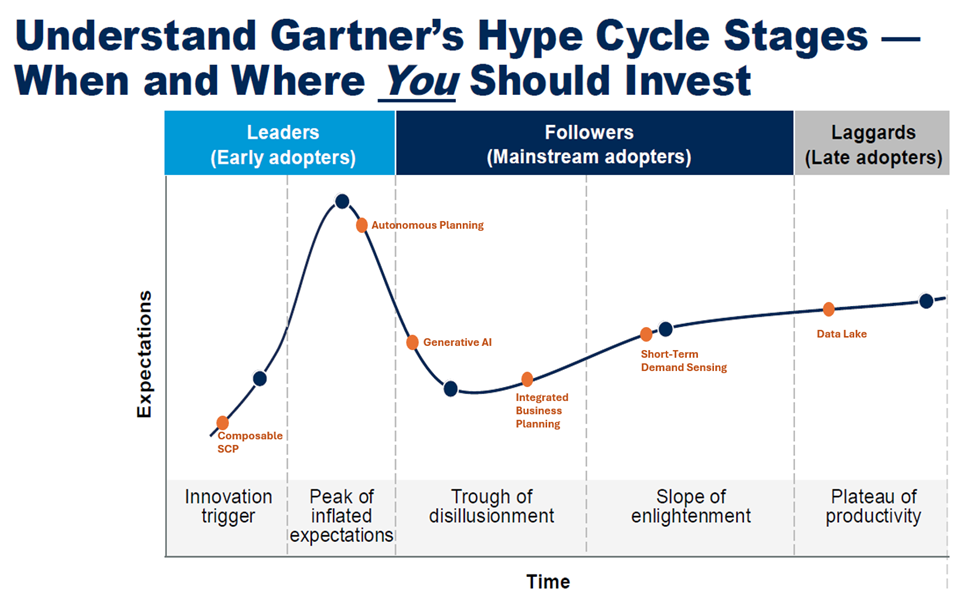
If you’ve seen a Gartner Hype Cycle, you know it maps technologies and techniques within a market according to their stage of maturity and adoption. The dots show the stages where analysts believe the technologies are at – the more to the left means the technology is emerging. On the right-hand side, technologies are more mature and mainstream.
What is often overlooked is that organizations also sit somewhere along a similar adoption curve.
According to the 2025 Gartner Supply Chain Technology User Wants and Needs Survey, 33% of companies fall under early adopters, 15% are late adopters, and 52% are somewhere in between. In other words, most organizations are not on the bleeding edge nor are they fully conservative. They sit somewhere in the middle.
Bottom line: Balance foundational and emerging technologies, while keeping in mind your organization’s maturity and appetite for risk. Avoid a “left-heavy” portfolio.
There is also a relationship between technology and maturity – a layering effect -such that where organizations improve their maturity, they also evolve their SCP IT landscape and progressively will need more advanced capabilities.
Maturity models don't tell the whole story. There is newer research on Supply Chain Personas that help to understand the "why" behind organizational behavior. These examine organizational characteristics such as leadership style, decision‑making style, business focus (inside‑out vs. outside‑in), employee treatment, culture, approach to change, agility, risk tolerance, and innovation posture.
I think this is an important dimension to consider because while there are a lot of different studies that measure what a company does from performance metrics, maturity, complexity … there are few that help us understand why companies do what they do and help to understand attitudes, aspirations, and behaviors which support the digital transformation journey.
From Table Stakes to Strategic Differentiators
Lets go back to the analogy of cars. Features like power windows, AC, backup cameras, and GPS were once premium; now they’re table stakes. In supply chain planning, the same is true— dashboards, what-if scenarios, collaboration, alerts, reports, are standard features. GenAI chatbots, as an example, were highlighted as new and innovative about a year ago and are quickly becoming standard features.
What matters is your current needs and next stage. That’s why I encourage thinking in terms of outcomes and life-cycle stage instead of just RFP feature lists. RFPs can be helpful, but too often they add noise when you don’t know how to vet them properly. Using the car analogy helps simplify the buying process and focus on what really matters.
The Seven Key Criteria Framework
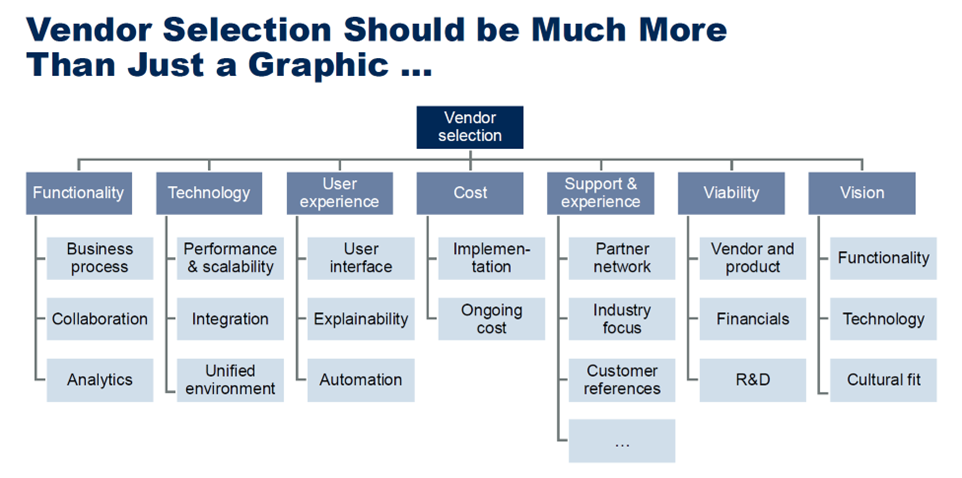
When you’re shopping for a car, there are usually some key criteria you’re thinking about. The same applies to evaluating software solutions. Here’s a framework I developed while at Gartner:
- Functionality
- Technology
- Usability
- Cost
- Customer Support
- Viability
- Vision
Depending on your needs and organizational maturity, some of these criteria may take on different weights (level of importance). Assign high, medium, and low to each one to help with the analysis.
Below is a summary of the seven key criteria I encourage supply chain leaders to anchor on when evaluating supply chain planning (SCP) technology. This is not about building a perfect scoring spreadsheet. It’s about ensuring you are evaluating tech vendors through the right lenses.
1. Functionality – Does It Support Your Business Priorities?
Functionality is still important, but it should be evaluated in the context of your maturity and roadmap – not in isolation.
The key question isn't "Does it have the most features?" but rather "Does it have the right features for our stage to help us create high quality plans?
Consider whether the solution supports the planning processes you're prioritizing—demand planning, supply planning, inventory planning, S&OP, etc. Does it enable the level of collaboration and analytics you realistically need today, and can it grow with you?
Here's what matters: Organizations should use functionality that's appropriate for their maturity level and refrain from using features that are too sophisticated for their process. Doing so may add a level of complexity that can stall widespread adoption of the tool.
As you progress from functionally focused planning to end-to-end planning, your needs will evolve. At lower maturity stages, you need support for functional best practices. As you mature, you'll need more sophisticated capabilities that focus on end-to-end decision making, process orchestration, and visibility.
More functionality is not always better. The right functionality for your stage is what matters.
2. Technology – Is the Foundation Scalable and Integrated?
Technology is about the underlying architecture and long-term scalability. When evaluating technology, the key is to find the right balance of characteristics to align with your vision and support your current and future planning processes.
Critical Considerations
- Performance and scalability: Can the solution handle your current data and transaction volume? As you mature and extend planning to trading partners, can it scale without impacting performance and speed?
- Integration: As organizations mature and expand planning from departmental to functional to multienterprise, they need to integrate with other systems beyond ERPs such as warehouse management systems (WMS), transportation management systems (TMS), manufacturing execution systems (MES), and easily add new data sources such as weather, point-of-sale, supplier risk, or social sentiment.
- Unified planning environment: Does the solution truly enable connected decisions across the enterprise and multiple planning decision layers OR is it simply linking functional modules? Historically, unified planning meant integrating demand, supply, replenishment, inventory , and other core functional blocks within a single data model. But today, increasingly the more important question is whether the system enables coherent, end-to-end decision-making and being in lockstep with the real world — aligning data, decision logic, workflows, and governance.
Your planning system will likely be in place for years. Ensure the technical foundation can evolve with your business.
3. Usability – Will People Actually Use It?
As the features and capabilities of SCP software have evolved, so has the user experience—focusing on the degree to which software can be easily, efficiently, and intuitively used. This goes beyond the look and feel, flexibility, and navigation but also enabling explainability and performance.
Good usability can mean different things to different people:
- User interface: Look at how effectively information is presented, how intuitive it is to navigate the software, and the ease of use in interacting with features and functionality. Analyzing data can be cumbersome—menu choices, multistep queries, drop-down filters, and data laid out in a gridlike format don't necessarily make the analysis and interaction experience easy.
- Data visualization and exploration: Seek solutions that offer more support than just traditional bar, line, map, and pie graphs. At a minimum, support diagnostic exploration of data where you can look for root causes and new insights—such as interactive dashboards, interactive supply chain network maps, embedded recommendations, and increasingly GenAI capabilities that support information discovery, summarization, and creation of new visuals on the fly. GenAI UIs are proliferating quickly, but the differentiator is whether they’re tied to governed decisions and measurable outcomes.
- Productivity: This looks at the level of support the software provides to reduce the amount of manual work a planner has to do, and the speed and analytical insights the planner receives from the solution. At the lower end of the maturity curve, organizations may seek exception management capabilities that automatically notify the planner of changes in the plan. As you move up the maturity curve, you'll seek support for predictive and prescriptive analytics to help automate planning processes and improve planning quality.
If planners revert to Excel, the investment fails—regardless of technical sophistication.
4. Cost – What Is the True Total Investment?
While cost is a very important criterion, it shouldn't have a disproportionate influence compared with other criteria. The key is to assess a vendor's ability to provide both overall business value and the appropriate level of technology support for your current-state and future-state needs.
Cost should be assessed holistically. Look beyond subscription price:
- Initial costs: Investment required to procure the solution (subscription) and initial implementation
- Ongoing costs: Postimplementation costs such as ongoing subscription fees, IT support, and ongoing training as well as GenAI usage fees and data costs.
Not all technology is created equal, and some solutions will be better at doing things than others. The key is to get the right technology, which often means not acquiring the "best" or deepest functionality, but rather the right blend of functional and nonfunctional capabilities.
The objective is not lowest cost—it's appropriate value for your strategy and maturity.
5. Customer Support – How Will the Vendor Partner With You?
Customer support goes beyond help desk tickets. This criterion refers to the vendor's holistic approach to engaging and supporting customers across different dimensions—from day-to-day standard product support to support for organizational change and ongoing education.
Assess the full spectrum of support:
- General support: The availability of help desk quality problem resolutions, breadth of support capabilities, and strong customer service.
- Organizational change, education, and training: SCP technology is changing rapidly as supply chains grow more complex and the pace of innovation speeds up. Consider the level of support you'll need in change management efforts, education, and training of resources.
- Vendor partner network: The ability to support your organization outside the vendor's "home" geography and to extend capabilities through technology and service partners. A partner ecosystem may offer regional/local support and complementary capabilities as your footprint and needs grow.
- Customer references: It's vital to talk with a vendor's customers to assess "real world" experience. Review the vendor customer reference list to find organizations with similar profiles—in how they use the solution, scale of deployment, enterprise size, and level of maturity.
- Partnership fit: How can you evaluate whether your organization and the vendor are compatible? Partnership fit speaks to the level of compatibility beyond delivering value—it touches on transparency, responsiveness, communication, collaboration, philosophy, and aptitude.
Technology transformations require ongoing partnership—not just software delivery.
6. Viability – Will the Vendor Be a Long-Term Partner?
Supply chain planning systems tend to be long-cycle investments even in today’s age. You're not just buying software for 12-18 months—you're committing to a platform that'll be core to your operations for many years. Given the relatively long life span of an SCP solution, it's important to assess the long-term viability of both the vendor and the product.
Evaluate
- Financial stability: A vendor's financial position is important because it gauges the level of financial strength and ability to continue with planned investments.
- Market presence and reputation: Long-term presence in the market and likelihood that the vendor will continue to invest in the product
- Continued product investment: Evidence of ongoing innovation and enhancement
A solution must be sustainable—not just innovative.
7. Vision – Can their Roadmap Support Your Future?
No vendor solution is perfect. More likely than not, no vendor will meet every single one of your needs and be within your budget. However, it's important to evaluate what capabilities you need today and in the future, and ensure that the vendor has a long-term vision and product roadmap that's favorable to your future needs.
What matters is:
- Functionality roadmap: The vendor's plans to evolve the product and deliver additional or enhanced functionality to support end-to-end SCP. This includes the vendor's ability to innovate its SCP solutions, provide support for your journey to mature planning processes, and provide a pathway from foundational capabilities into differentiating capabilities.
- Technology evolution: As leading companies improve their maturity, they also evolve their SCP IT landscapes. How is the vendor's architecture evolving to support composable architectures that emphasizes governance and user experience? Tighter links between planning and execution? How are they infusing decision intelligence techniques into the platform? How are they helping organizations to manage uncertainty? What's their roadmap to incorporate new and emerging technologies?
- Industry focus: The vendor's long-term strategy to direct resources, skills, and offerings to meet the needs of individual market segments. Each industry has unique nuances—retailers want strong omnichannel support; breweries need tank mixing and scheduling features, and so on. Assess the vendor's level of commitment to supporting your specific industry.
You are not just buying current functionality. You are buying into a vision and direction.
Final Thought: Weighting Matters
The seven criteria are not ranked in importance. Their relevance depends on your:
- Your corporate strategy
- Risk tolerance
- Current planning maturity
- Growth ambitions
- Cultural readiness for change
Too often organizations jump into an RFP without agreeing on what truly matters and how each criterion should be weighted. The result is noise, feature overload, and misalignment.
Think of it like buying a car: A teenager learning to drive doesn't need the same features as a growing family. A daily commuter has different priorities than someone who needs to haul heavy equipment for their business. The "best" car is the one that fits your needs at your stage—not the one with the most features or the highest price tag.
The same principle applies to supply chain planning technology. Strong technology decisions begin with clarity.
Know your priorities. Weight them deliberately. Then evaluate vendors through that disciplined lens.

Sign up for ideas worth revisiting.
Stay connected with updates on our projects, process, and what we’re learning along the way.
TABLE OF CONTENT